
How to Search Criminal Dockets
Nebraska's JUSTICE one-time name search is where most people begin. Accept its terms, and the name form opens. From there, narrow by court, Banner County, case type, year, and case number. Do that if you know those details. The JUSTICE FAQ warns that this searches party names, not witnesses. A hit leads to the case summary and the register of actions. That register is the dated log of filings and court activity.
Pick the right court before you give up. Misdemeanors, traffic cases, and felony preliminary hearings sit in Banner County Court. A felony bound over on probable cause then appears in Banner District Court. JUSTICE refreshes nightly. Fresh filings can lag a week. Recheck spelling, court type, year, and case type before trying a public terminal or calling the clerk.
- Acknowledge the JUSTICE terms and enter the party name or case number.
- Select County Court or District Court, then choose Banner and the criminal case type.
- Add a year or case number when known to narrow similar names.
- Open the case summary and register of actions to review events, orders, and settings.
- Use the case number and court when requesting a public copy from the clerk.
Remember the offline routes. A courthouse public terminal, a clerk call, or a written copy request can fill gaps an online result leaves.
Banner Criminal JUSTICE Filters
The state search splits County Court from District Court for good reason. A subscriber can run a criminal lookup by party name, court, county, case type, subtype, year, judge, or attorney. The one-time search sticks to party names. Choose Banner plus the right court. One statewide result set will not hold every criminal case. A court case identifier mixes court or county context with case type, filing year, and a sequential number. Copy its formatting exactly rather than guessing.
The official criminal and traffic search demonstration walks through the court, county, case-type, year, and case-number choices. Those choices narrow a Banner criminal docket search.
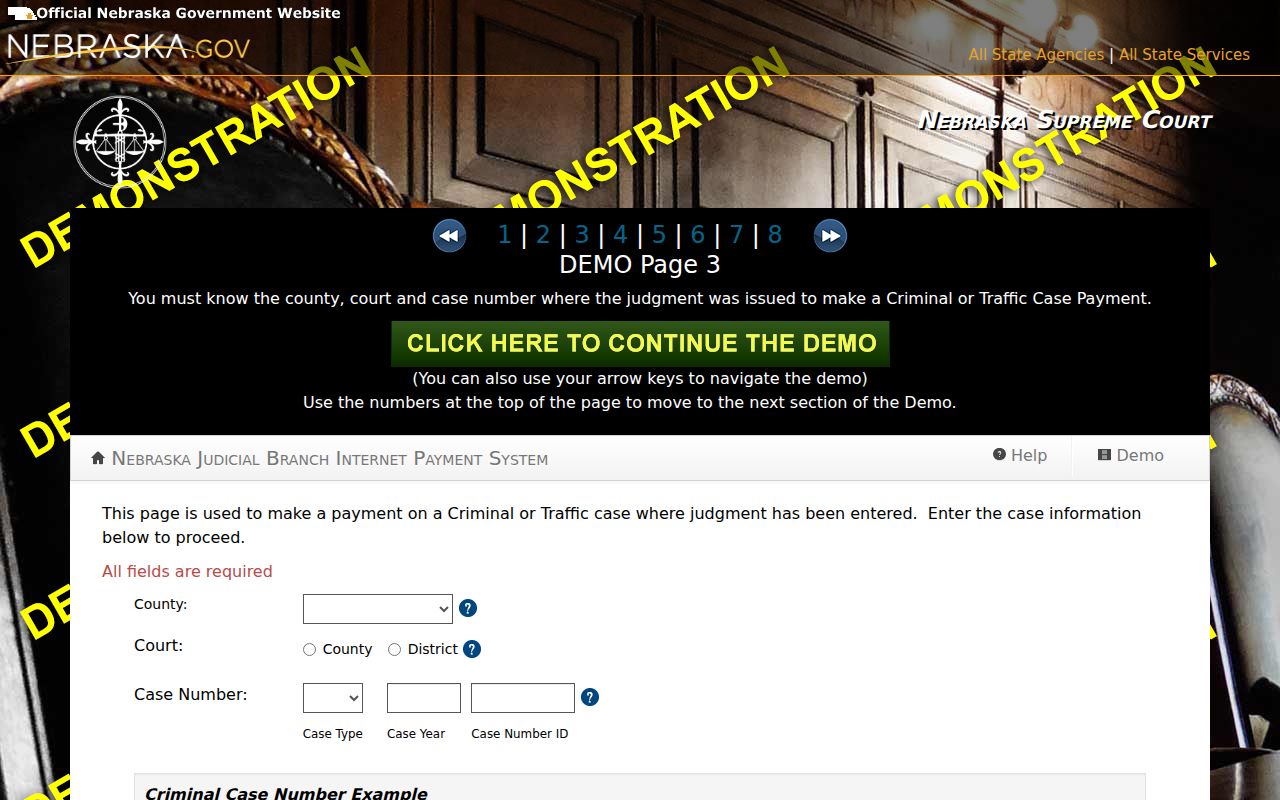
Those filters shine when a name is common or the filing year is known. A case-number hit is the straightest path to the matching register.
What a Criminal Docket Shows
A Banner criminal docket shows court procedure. It is not a conclusion about a person or a criminal-history report. The case summary lists the court, case ID, caption, judge, case type, filing date, status, and disposition once entered. The register of actions gives the dated sequence: charges, hearings, motions, pleas, orders, sentencing entries, costs, and links to any imaged filings. Those links stay subject to public access limits. A charge is only an allegation at first. What the court decided appears later. It shows up in the plea, verdict, dismissal, acquittal, conviction, sentence, or final order.
| Case ID | A court, case type, filing year, and sequential identifier, such as CR 2025 000123 when displayed by the court. |
|---|---|
| Party and charge | The defendant role and publicly displayed offense or filing information. |
| Settings | Arraignment, preliminary hearing, motion, pretrial, trial, or sentencing dates and results. |
| Register entry | A dated action showing a filing, order, notice, hearing, or other court event. |
| Disposition | The case-resolving result, which should be read with the controlling order when available. |
The official district records-maintenance rule identifies the register of actions and its required fields.
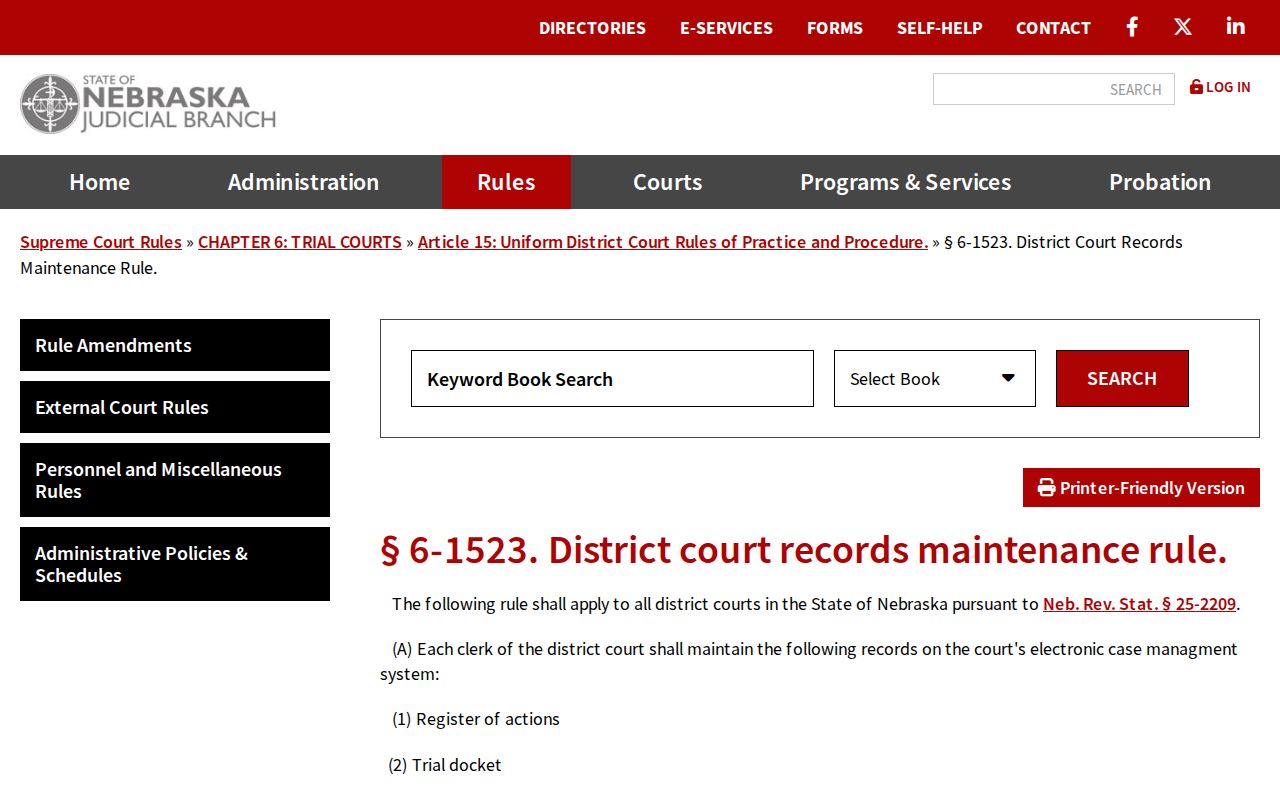
For Banner District Court, the register is the official chronological summary. The full case file may hold documents that were never imaged for the public. Initial and later filing dates help you place each entry in order.
Banner Felony Docket Court Split
Banner County Court and Banner District Court keep different criminal dockets. The county court takes misdemeanors, traffic matters, and felony preliminary hearings. A preliminary hearing tests probable cause. If the judge binds a felony over, the district court takes the felony proceeding. It handles it from trial through sentencing. Anyone tracking a serious case should search both courts. The county-court preliminary record and the district-court felony record sit in separate case files.
| Court | Criminal docket role | Search route |
|---|---|---|
| Banner County Court | Misdemeanors, traffic, and felony preliminary hearings | JUSTICE County Court, then Banner |
| Banner District Court | Felony cases after bind-over and later felony proceedings | JUSTICE District Court, then Banner |
Nebraska's county-court overview explains the preliminary-hearing role, and the Banner District Court directory points to the district-court record channel.
Stages on a Criminal Docket
Criminal dockets usually open with a complaint or information. An appearance or arraignment follows. The register may then log bond activity, a preliminary hearing, motions, pretrial settings, a plea, a trial, and sentencing. No two cases run the same course, though. A county-court felony matter can gain a district-court phase after bind-over, and post-judgment entries may follow. A listed hearing is just a setting. A later entry or order shows what actually happened.
Criminal docket process: Filing → Arraignment → Pretrial → Plea or Trial → Disposition → Sentencing.
“Disposition” means the court's resolving entry. “Closed” is only a case-status label. Neither replaces reading the final order or sentence when it is public.
Banner Criminal Docket Terms
Short docket labels carry distinct meanings. Read them in sequence. That way you can tell an allegation, a scheduled event, and a final ruling apart. Banner criminal records follow Nebraska court vocabulary, including register of actions for the running court record.
- Complaint
- The charging document filed to start a criminal case. It does not prove the charge.
- Arraignment
- An appearance where charges and procedural rights are addressed.
- Preliminary hearing
- A county-court proceeding that can result in a felony bind-over after a probable-cause finding.
- Bind over
- The transfer of a felony case from county court to district-court proceedings.
- Disposition
- The case-resolving result, such as a dismissal, plea outcome, verdict, or other court action.
These labels describe court procedure only. A later order often adds detail a short register entry leaves out.
Which Court Holds Criminal Dockets
Two offices split the Banner County criminal docket work. District-court record questions belong to Katie West, the Banner County Clerk and Clerk of District Court, at 204 State Street, Harrisburg, Nebraska 69345. District mail goes to P.O. Box 67, Harrisburg, NE 69345. County-court criminal, traffic, and preliminary-hearing matters run through Clerk Magistrate Dianne Lana, who serves Banner County Court from a remote Scotts Bluff office at P.O. Box 133, Gering, NE 69341. Check which court holds your file before mailing anything. The county-court service route and the district-court record custody are simply different tracks.
Banner District Court records
Katie West, Clerk of District Court
204 State Street, Harrisburg, NE 69345
P.O. Box 67, Harrisburg, NE 69345
308-436-5265
Banner County Court records
Dianne Lana, Clerk Magistrate
P.O. Box 133, Gering, NE 69341
Remote service through Scotts Bluff County Court
308-436-5268
The official Banner County Court listing confirms the county-court route and remote staffing arrangement.
Banner Criminal Arraignment Route
Arraignments in Banner County follow a set pattern. Criminal and traffic arraignment dockets are listed for the first Wednesday of each month at 11:00 a.m., held in the Scotts Bluff County Courthouse in Gering. Other county-court hearings get scheduled as needed at an appropriate location. That remote arrangement does not shift the whole case to Scotts Bluff County. The Banner County Court page notes that jury trials still run in Banner County. A recurring arraignment listing is not a personal hearing notice, so confirm your setting through the case register, the statewide calendar, or the clerk. This split is exactly why the location field on each docket entry matters. Court type, event, and the latest order together tell you where and when a proceeding happens.
Public Access and Sealed Criminal Dockets
Nebraska Article 8 opens public access through JUSTICE, authorized providers, and public terminals. Several categories stay open to the public. These include party indexes, case summaries, registers of actions with available images, calendars, and judgment or order summaries. The access has limits, though. Juvenile, sealed, restricted, confidential, adoption, and protected criminal-history material may be absent, redacted, or unavailable. An attachment can stay nonpublic even when the case summary is open to anyone. And a missing record or image does not tell you why it is absent.
Sealed-access rule: A sealed criminal record is not available through a general public search. The person whose record was sealed may use the court's DC 1:12 release process when eligible; valid identification and court-specific requirements apply. Ask the clerk which court holds the case rather than treating a closed, dismissed, or set-aside entry as proof that the record is sealed.
Two sets of rules govern what you can see. The Article 8 public-access rules lay out which categories of court records stay open. The Nebraska Public Records Act covers your right to inspect and copy records, with some exceptions. Want a plain or certified copy of a case file? You request it through form CC 3:29. A downloaded image will not carry the clerk's certification. So it is not the same thing.
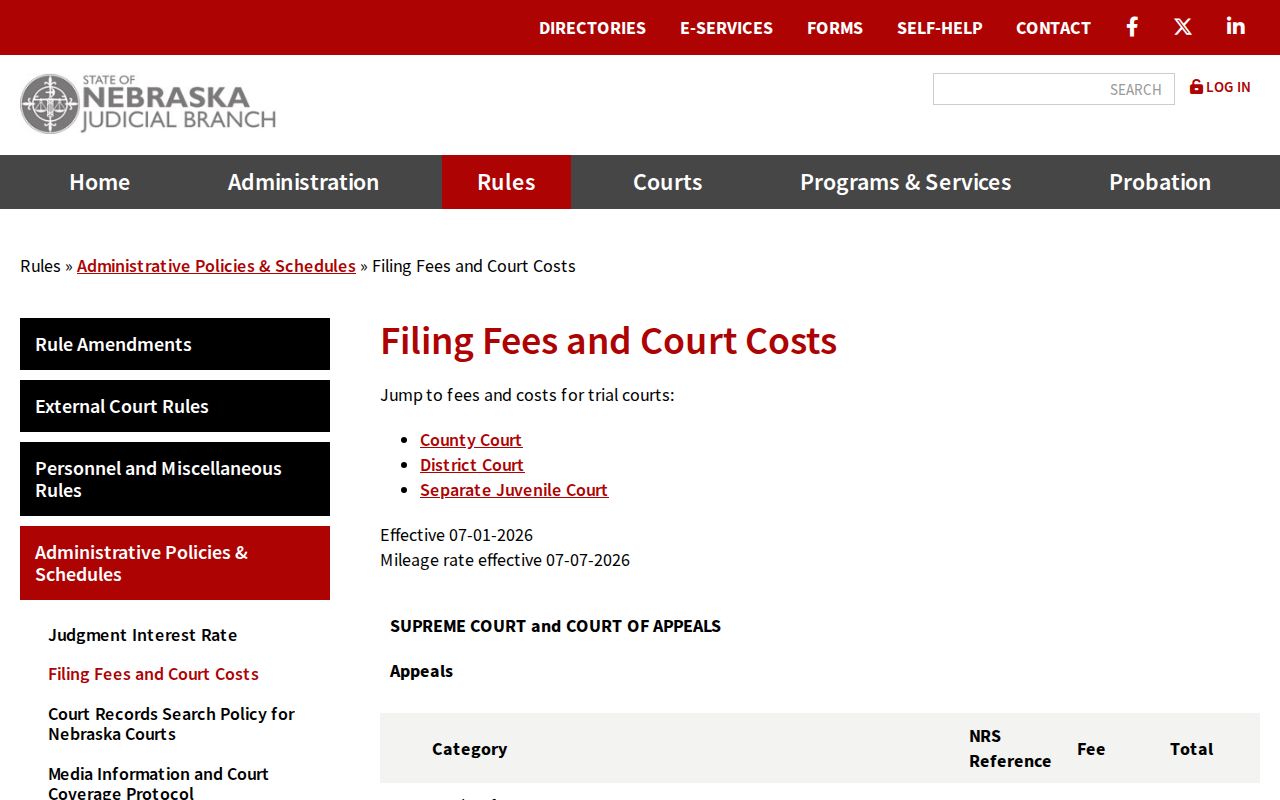
For fees, one page settles it. The Judicial Branch fee schedule lists the current filing fees and court costs. It is the official word whenever a number is in doubt.
When you order criminal docket copies, give the clerk the court and the case number. That detail routes the request to the correct Banner file.
Banner Criminal Docket Filing Snapshot
The official FY 2025 district-court report lists 13 Banner District Court filings. Criminal categories account for 2 felony filings plus 2 other criminal filings. Read these as filed-case counts for the reporting year alone. They are not open cases, people, hearings, or documents. They are not a pending-docket total either. County-court figures sit on a separate ledger. They should never be combined with this district-court row.
The FY 2025 district-court caseload report supplies the Banner row and its filing-count context.